
Food Delivered Botanical Therapeutics for Cardiometabolic Resilience
ReCocoa manufactures natural botanically derived medicines delivered through everyday food products that meet the EFSA and FDA Heart Health Claim on endothelial function. We are advancing toward the next generation of botanical medical drugs targeting oxidative stress, cardiovascular decline and metabolic dysfunction [Diabetes, Obesity, Cardiovascular Diseases]. This will be a Precision Health Care Technology of the future.
- Stage
- Clinical Trials
- Model
- Therapeutic Platform & Global Licencing
- Base
- Scottish Borders & Northumberland
The global cardiometabolic challenge.
0m
Obesity
Adults living with obesity worldwide. Obesity is a major upstream driver of metabolic dysfunction.
Source1
0.00bn
Hypertension
Adults aged 30–79 with hypertension; roughly four in five are inadequately treated.
Source4
Obesity, insulin resistance, prediabetes, type 2 diabetes and hypertension are interconnected components of a growing global cardiometabolic health challenge. Together, they contribute substantially to cardiovascular disease and reduced healthspan.5,7
- Obesity + metabolic dysfunctionUPSTREAM
- Insulin resistanceMECHANISM
- Prediabetes · Type 2 diabetesOVERLAPPING
- Hypertension · Cardiovascular diseaseDOWNSTREAM
- Reduced healthspanOUTCOME
Pathways are interconnected and overlapping, not a mandatory sequence; individuals do not progress through every stage. This is context only. ReCocoa makes no claim to treat or prevent obesity, diabetes, hypertension or cardiovascular disease.
The cardiometabolic crisis is accelerating.
Obesity, insulin resistance, prediabetes, type 2 diabetes, hypertension and cardiovascular disease are recorded as separate diagnoses. They are stages of one interconnected metabolic and vascular decline. Risk compounds long before diagnosis, so health systems meet these conditions late and at their most expensive.2,4,7
- 01
Obesity & Metabolic Dysfunction
Excess adiposity drives ectopic fat, oxidative stress and low grade inflammation.
- 02
Insulin Resistance
Tissues respond less efficiently to insulin; compensatory hyperinsulinaemia follows.
- 03
Prediabetes
Glucose regulation deteriorates before any diabetes diagnosis is made.
- 04
Type 2 Diabetes
Sustained dysglycaemia accelerates vascular and renal damage.
- 05
Hypertension & Cardiovascular Risk
Endothelial dysfunction raises pressure and amplifies cardiovascular risk.
- 06
Reduced Healthspan
Healthy, independent years lost decades before life expectancy is reached.
- PLATFORM
ReCocoa Flavanol Platform
A characterised bioactive flavanol platform investigating the shared upstream biology.
This sequence illustrates interconnected cardiometabolic risk at population level. It is not a claim that every individual follows this pathway. ReCocoa makes no claim to treat, prevent or cure obesity, diabetes, hypertension or cardiovascular disease.
Different Diseases. Shared Biology.
Cardiovascular disease, type 2 diabetes and hypertension are usually treated as separate conditions. They share upstream biology: ageing related inflammation and declining vascular function, both established and independently quantified contributors to cardiometabolic risk. ReCocoa is investigating that shared biology rather than a single downstream condition.7,4
- 01
Ageing
Cumulative cellular and metabolic burden.
- 02
Inflammation
Chronic low-grade inflammatory signalling.
- 03
Vascular Dysfunction
Reduced endothelial performance.
- 04
Cardiometabolic Disease
Convergent clinical outcomes.
- 05
Reduced Healthspan
Years of healthy life lost.
What the literature supports and what it does not.
ReCocoa has no clinical data as yet. Everything below is published third-party evidence that defines the opportunity and its limits. Each claim is stated with its limitation.
A regulator has already accepted a cocoa flavanol vascular claim.8
EFSA concluded that 200 mg of cocoa flavanols daily contributes to maintaining endothelium-dependent vasodilation, which supports normal blood flow. This is an authorised EU claim on a characterised flavanol intake, not on cocoa products generally.
LIMITATION
The claim covers maintenance of normal vascular function in healthy adults. It is not a disease-treatment claim, and it does not apply to ReCocoa material until our own composition is characterised against the same specification.
The largest randomised trial of cocoa flavanols was informative but not positive.9
COSMOS randomised 21,442 older adults to a cocoa extract supplement or placebo. The primary composite cardiovascular endpoint was not significantly reduced (HR 0.97). A pre-specified secondary analysis of cardiovascular death showed a 27% reduction, and adherence-adjusted analyses were more favourable.
LIMITATION
A non-significant primary endpoint is a non-significant primary endpoint. Secondary and per-protocol findings are hypothesis-generating only. Any ReCocoa programme must be designed to test, not to assume, this signal.
The mechanism has a named molecule and a measurable readout.10,8
Human studies attribute flavanol-associated improvements in flow-mediated dilation to (−)-epicatechin and nitric-oxide-dependent signalling, giving a defined analyte to standardise on and a validated surrogate endpoint to measure.
LIMITATION
A plausible mechanism and a surrogate endpoint are not clinical outcomes. Endothelial function endpoints must be complemented by longer, harder outcome measures before any therapeutic positioning.
Conventional processing destroys most of the active fraction.11
Fermentation, roasting and alkalisation progressively degrade epicatechin and catechin; heavily Dutch-processed cocoa retains only a small fraction of the flavanols present in the unprocessed bean. Retention, not sourcing, is the rate-limiting step.
LIMITATION
Published degradation data describe conventional industrial processes. ReCocoa's retention performance is unpublished and will only be stated once third-party analytical data exists.
From botanical input to characterised bioactive.
- STAGE 01
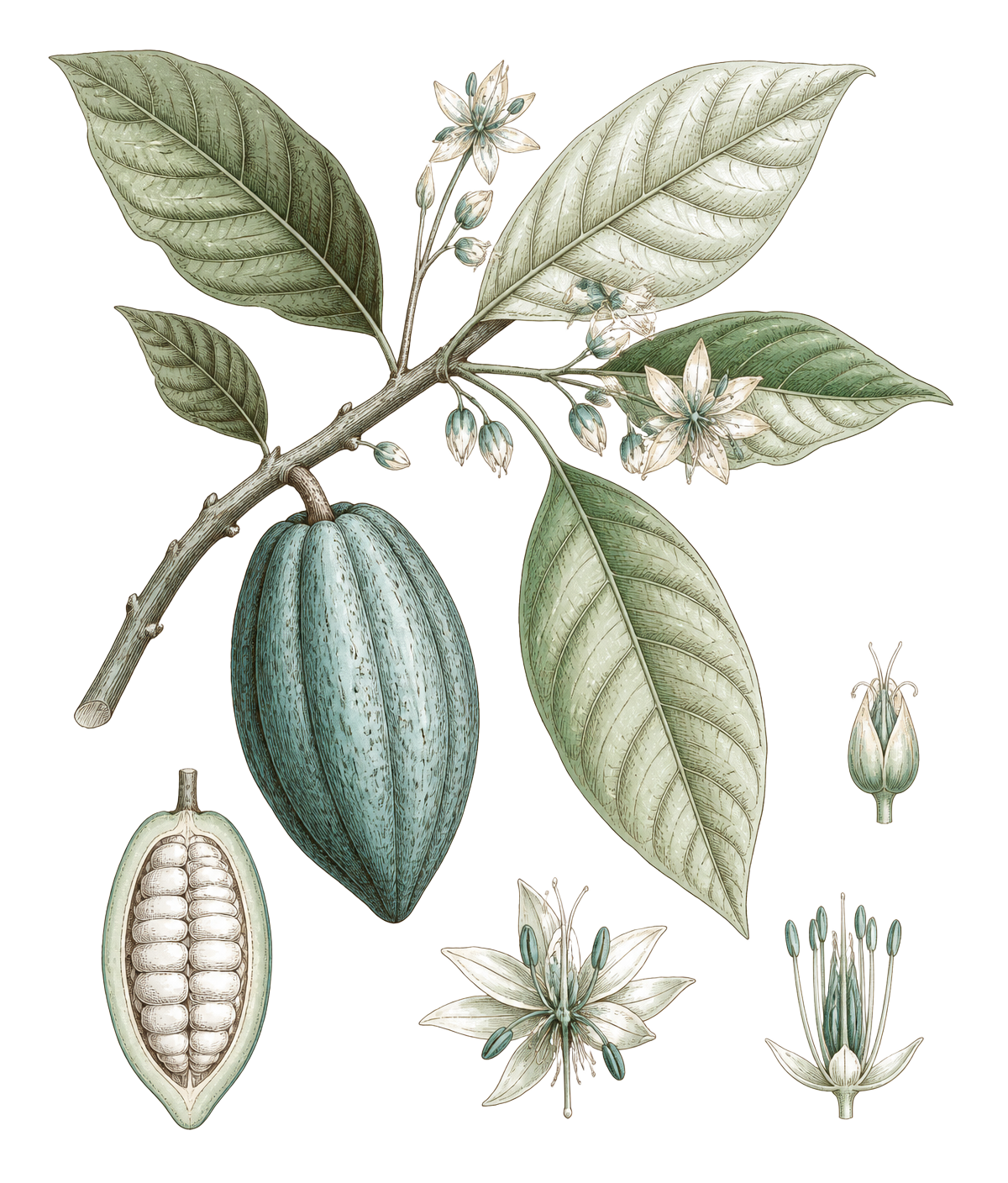
Natural Cacao
Responsibly sourced botanical input material.
- STAGE 02
Proprietary Processing
UK and EU Process patent approved.
- STAGE 03
Bioactive Flavanols
Characterised, standardised flavanol fractions.
- STAGE 04
Scientific Validation
Independent validation completed.
- STAGE 05
Future Health Applications
Formats spanning food to future medicines.
Analytical characterisation and independent validation work is described where it exists; nothing on this site should be read as a clinical outcome or a treatment claim. Every figure and mechanism cited on this page is drawn from the published third-party sources listed below.
One Technology. Multiple Applications.
Cardiovascular Health
Vascular function as the first area of scientific focus and evaluation.
Metabolic Health
Cardiometabolic pathways where inflammation and vascular biology converge.
Healthy Ageing
Extending healthspan through mechanisms shared across diseases of ageing.
Scientific Partnerships
Collaborative research with universities and research institutes.
Global Licensing
Platform licensing to ingredient, food and pharmaceutical partners.
An industrial biotechnology base, built for scale.
- 01
Industrial Biotechnology
A base for process development and industrial bioprocessing, close to the founding team.
- 02
Advanced Manufacturing
Process designed for scale-up alongside established UK manufacturing capability.
- 03
Universities
Access to UK life sciences research strength and clinical academic networks.
- 04
Export Opportunity
High-value, IP-led exports into global health and ingredient markets.
- 05
Innovation
Public innovation support aligned to translational science and scale.
Why this belongs in an industrial strategy, not a product catalogue.
ReCocoa is being built as a platform technology, not a consumer product. Its value is realised through validated science, licensed manufacturing and export. That is how national biotechnology capability converts into economic and clinical return.
Economic Impact
IP-led value creation in a sector the UK Industrial Strategy identifies as a growth priority: engineering biology, life sciences and advanced manufacturing.
Export Potential
Characterised bioactive fractions are low-volume, high-value and shippable. That gives a UK manufacturing base direct access to global ingredient and pharmaceutical markets.
Manufacturing Capability
Designed for continuous industrial bioprocessing rather than batch craft production, so scale-up is an engineering exercise, not a reinvention.
University Collaboration
Analytical characterisation, mechanistic review and independent human study design carried out with academic and clinical partners, not in-house.
Global Licensing
One platform, licensed by territory, category and format. Licensing is how a national technology reaches international scale.
Patient Impact
Cardiometabolic disease and population ageing are the dominant burden on health systems. Upstream vascular biology is where prevention has leverage.
Built with research institutions and national innovation partners.
UK Universities and IUK
Approach stage
Analytical laboratories in the UK & EU
Scoping quotations
Clinical Trials
Not Yet ENGAGED.PENDING
Ingredient & pharma licensees
Not yet engaged
Status shown against each organisation is factual as of this page's last update. We do not display institutional marks or imply endorsement before an agreement is executed.
A staged path from validation to global platform.
- 2026
Foundation
Company formation, IP position and study design.
- 2027
Clinical Validation
Independent endothelial-function study, externally run.
- 2028
Manufacturing Scale-Up
Process scale-up with manufacturing partners.
- 2029
Global Partnerships
Strategic ingredient and pharmaceutical alliances.
- 2030
Licensing
Territory and category licensing.
- 2031+
Global Platform
Multi-indication platform expansion.
Dates are planning targets, not commitments. Each stage is gated on the preceding stage producing data that survives independent review.
References
- 01World Health Organization. Obesity and overweight — fact sheet. WHO, 2024. Source
- 02International Diabetes Federation. IDF Diabetes Atlas, 11th edition. IDF, 2025. Source
- 03International Diabetes Federation. IDF Diabetes Atlas — impaired glucose tolerance. IDF, 2025. Source
- 04World Health Organization. Global report on hypertension: the race against a silent killer. WHO, 2023. Source
- 05World Health Organization. Cardiovascular diseases (CVDs) — fact sheet. WHO, Geneva. Source
- 06World Health Organization. Ageing and health — fact sheet. WHO, Geneva. Source
- 07GBD 2021 Risk Factors Collaborators. Global burden and strength of evidence for 88 risk factors, 1990–2021. The Lancet 2024;403(10440):2162–2203. Source
- 08EFSA Panel on Dietetic Products, Nutrition and Allergies. Scientific Opinion on the substantiation of a health claim related to cocoa flavanols and maintenance of normal endothelium-dependent vasodilation. EFSA Journal 2012;10(7):2809. Source
- 09Sesso HD, Manson JE, Aragaki AK, et al.. Effect of cocoa flavanol supplementation for the prevention of cardiovascular disease events: the COSMOS randomized clinical trial. Am J Clin Nutr 2022;115(6):1490–1500. Source
- 10Schroeter H, Heiss C, Balzer J, et al.. (−)-Epicatechin mediates beneficial effects of flavanol-rich cocoa on vascular function in humans. PNAS 2006;103(4):1024–1029. Source
- 11Payne MJ, Hurst WJ, Miller KB, et al.. Impact of fermentation, drying, roasting and Dutch processing on epicatechin and catechin content of cacao beans and cocoa ingredients. J Agric Food Chem 2010;58(19):10518–10527. Source
A platform is built with institutions, not sold to customers.
We are open to conversations with governments, universities, funders and manufacturing partners.